

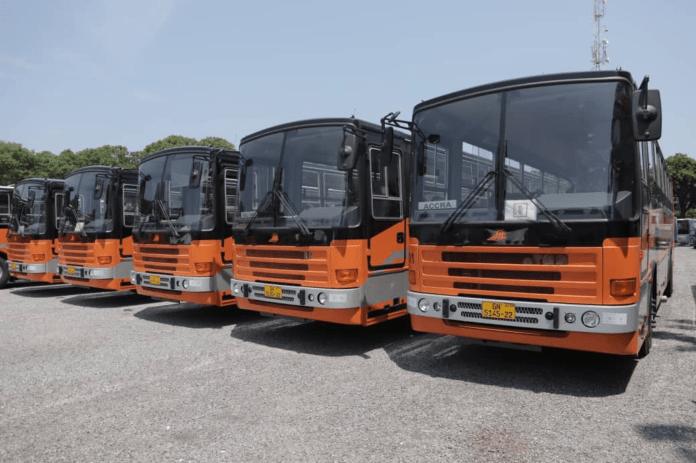
The Deputy Managing Director of Metro Mass Transit, Haroun Apaw-Wiredu, has attributed the persistent breakdown of the company’s buses to severe spare parts challenges, compounded by procurement decisions made under previous administrations.
Speaking in an exclusive interview with Alfred Ocansey on KeyPoints on January 24, Mr. Apaw-Wiredu explained that many of Metro Mass’ buses rely on spare parts that are not available locally, making maintenance both difficult and costly.
According to him, management has often been forced to send faulty components to countries such as China and South Korea, where manufacturers attempt to fabricate replacement parts. However, this process has not always yielded positive results.
“In many instances, when those parts are supplied back to us, they do not fit the mechanical problem identified,” he revealed.
He noted that these mismatches frequently leave buses grounded, as replacing one defective part does not necessarily resolve the deeper mechanical fault. In some cases, entire components have had to be returned to China for further work, further delaying repairs.
Although some of the parts have since been returned, Mr. Apaw-Wiredu admitted that the challenges persist, particularly with buses that were not designed with Ghana’s climate and operating conditions in mind.
He contrasted these problematic buses with others in Metro Mass’ fleet acquired through a government-to-government agreement between Ghana and the Netherlands, which he described as far more durable.
“These buses are very robust. They are strong enough,” he said, adding that the Dutch-supported arrangement, which began under a previous administration, saw Metro Mass receive several batches of buses between 2022 and 2024, with the final consignment of about 50 buses arriving in 2024.
On the issue of broken-down vehicles, Mr. Apaw-Wiredu confirmed that a significant number of the 99 buses previously cited are currently not roadworthy, largely due to spare parts shortages and long-standing mechanical faults.
To tackle the problem, Metro Mass has established an internal technical committee comprising staff from the technical department and other relevant units to assess the condition of buses across the country.
“The moment a serious mechanical fault is detected, the bus is grounded. That is the current state of affairs,” he stated.
He stressed that past procurement decisions failed to adequately consider Ghana’s weather and environmental conditions, a factor he said has contributed significantly to the frequent breakdowns.
As part of measures to ensure accountability, Mr. Apaw-Wiredu disclosed that Metro Mass has commissioned an external audit into its procurement processes and operational challenges.
“We will submit everything to the Ministry for the necessary steps to be taken,” he assured.