

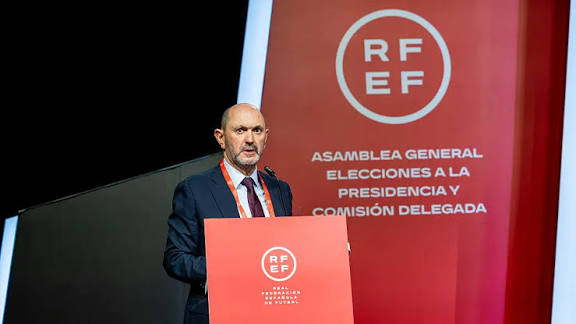
The President of the Spanish Football Federation (RFEF), Rafael Louzán, has expressed strong confidence that Spain will host the final of the 2030 FIFA World Cup, a tournament set to be jointly staged by Spain, Portugal, and Morocco.
Speaking at an event organized by the Madrid Sports Press Association, Louzán praised Spain’s long-standing track record in hosting major international competitions, describing the country as well-prepared to lead the organization of the historic tournament.
“Spain has proven its organizational capacity over many years. It will be the leader of the 2030 World Cup, and the final will be held here,” he stated.
Although FIFA has not yet confirmed the venue for the final, two Spanish stadiums are already emerging as leading contenders: Madrid’s Santiago Bernabéu Stadium and Barcelona’s Camp Nou. Both iconic venues have recently undergone major renovations, enhancing their suitability to host football’s most prestigious match.
However, Spain is not the only country eyeing the final. Morocco is also pushing to host the showpiece match at its new Grand Stade Hassan II, currently under construction in Casablanca. Once completed, the stadium is expected to hold up to 115,000 spectators, which would make it one of the largest football stadiums in the world.
The President of Morocco’s Royal Football Federation (FRMF), Faouzi Lekjaa, has openly expressed his desire for the World Cup final to be played in Casablanca. The stadium’s design, inspired by a traditional Moroccan tent, aims to reflect the nation’s cultural heritage while showcasing modern architectural ambition.
Despite Morocco’s impressive infrastructure developments, Louzán acknowledged that the country still faces challenges. He referenced concerns raised during Morocco’s recent hosting of the Africa Cup of Nations, where disorderly scenes during the final between Senegal and Morocco drew criticism.
“Morocco is really undergoing a transformation in every sense, with magnificent stadiums,” Louzán said, while cautioning that organizational lapses could negatively affect the image of global football.
Ultimately, the decision on where the 2030 World Cup final will be played rests with FIFA. The world football governing body has already indicated that it is too early to make a final call. By comparison, the host venue for the 2026 World Cup final was only announced two years before the tournament.
As preparations continue, anticipation is building across Europe and Africa for what promises to be one of the most unique World Cups in football history spanning three countries and two continents.