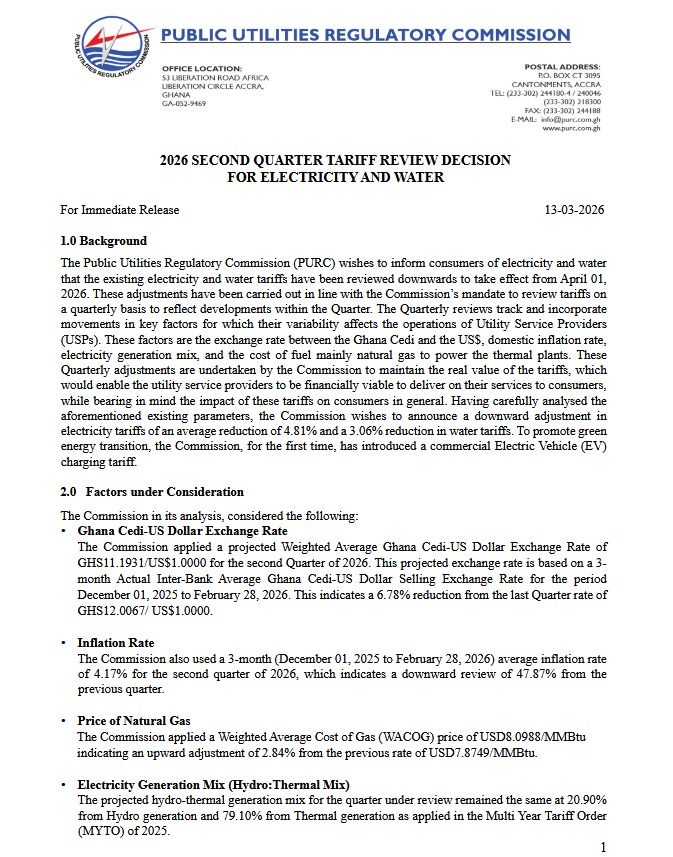


The Public Utilities Regulatory Commission (PURC) has announced a reduction in electricity and water tariffs, offering modest financial relief to consumers across the country. The revised tariffs, which take effect from April 1, 2026, follow the Commission’s routine quarterly review of economic indicators and operational costs that influence utility pricing.
The decision was communicated in a press release dated March 13, 2026, where the Commission explained that such adjustments are necessary to balance affordability for consumers with the financial stability of utility service providers
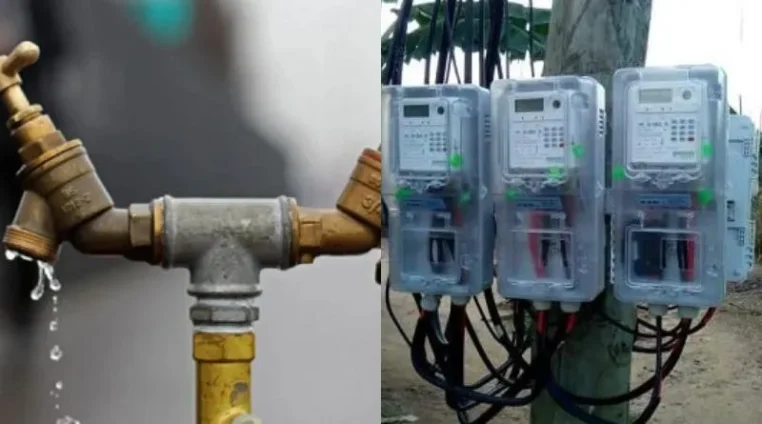
According to PURC, electricity tariffs will decrease by an average of 4.81 percent, while water tariffs will be reduced by 3.06 percent. The Commission noted that these changes reflect recent improvements in key economic conditions, particularly the Ghana cedi’s performance against the US dollar and declining inflation. It emphasized that the quarterly reviews are designed not only to adjust prices but also to ensure that service providers can continue to operate effectively without placing undue burden on consumers.
“These quarterly adjustments are undertaken by the Commission to maintain the real value of the tariffs, which would enable the utility service providers to be financially viable to deliver on their services to consumers, while bearing in mind the impact of these tariffs on consumers in general,” the statement said.
A major factor behind the reduction is the projected exchange rate for the second quarter of 2026, which PURC placed at GHS 11.1931 to one US dollar. This represents a notable improvement from the previous quarter’s rate of GHS 12.0067, amounting to a 6.78 percent reduction. Inflation also showed significant decline, with a three-month average rate of 4.17 percent recorded between December 2025 and February 2026 nearly half of what was used in the previous review. These developments helped ease upward pressure on tariffs and contributed to the downward adjustment
However, not all indicators moved in a favorable direction. The cost of natural gas, which fuels the country’s thermal power plants, increased slightly. PURC applied a weighted average gas price of 8.0988 US dollars per MMBtu, representing a 2.84 percent rise from the previous rate. Despite this increase, the overall effect of the improved exchange rate and lower inflation outweighed the higher fuel cost. The electricity generation mix also remained unchanged, with 20.9 percent from hydro sources and 79.1 percent from thermal generation, consistent with projections under the 2025 Multi-Year Tariff Order.
In a move signaling Ghana’s gradual shift toward sustainable energy and transport, PURC also announced the introduction of a new tariff category for commercial electric vehicle charging the first of its kind in the country. The Commission described this step as part of efforts to support the transition to cleaner energy solutions and prepare the utility sector for emerging technologies
“To promote green energy transition, the Commission, for the first time, has introduced a commercial Electric Vehicle (EV) charging tariff,” PURC stated.