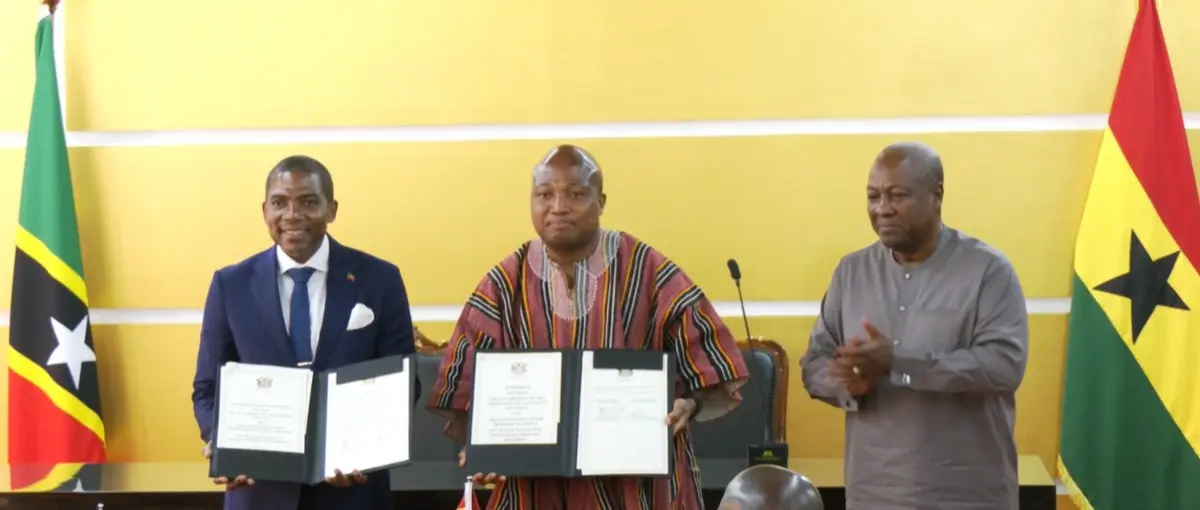



Attorney-General and Minister for Justice, Dr Dominic Akuritinga Ayine, has given a detailed explanation for the state’s decision to discontinue criminal charges against former Finance Minister Dr Kwabena Duffour and other directors of the defunct Unibank Ghana Limited, insisting that investigations found no evidence of theft, fraud or personal enrichment.
Speaking in an interview on Starr Chat with broadcaster Bola Ray, Dr Ayine said public opinion surrounding the Unibank collapse had largely been influenced by the prominence of the Duffour family rather than the legal and evidential standards required to sustain a criminal prosecution.
According to the Attorney-General, a comprehensive review of cases arising from Ghana’s financial sector clean-up revealed that Unibank’s circumstances were fundamentally different from other failed banks where criminal conduct was clearly established.
He contrasted the Unibank case with that of Capital Bank, where prosecutors uncovered what he described as unmistakable evidence of criminal wrongdoing.
“In the Capital Bank trial, there was evidence that whenever liquidity support was provided by the Bank of Ghana, the former managing director dishonestly appropriated those funds,” Dr Ayine explained.
He said investigators were able to trace how some of the liquidity support was physically diverted for private use, including evidence that cash was transported in a vehicle to a private garage at the managing director’s residence, supported by geographic tracking data.
“That is pure stealing,” he stressed, noting that such direct evidence made the Capital Bank case clearly prosecutable.
Turning to Unibank, Dr Ayine warned against equating bank failure with criminal liability, especially where liquidity support was used through normal banking processes.
“If liquidity support is applied in accordance with normal banking rules and the bank still collapses, you cannot criminalise the conduct of the owners or directors simply because the risk did not pay off,” he said.
He emphasised that risk-taking is intrinsic to banking and that loan defaults or business failure, though unfortunate, do not in themselves constitute crimes.
“You cannot turn around and say that because a bank received liquidity support and later failed, its directors must be prosecuted for causing financial loss to the state. It doesn’t happen anywhere,” he added.
Dr Ayine maintained that criminal law cannot be used to punish poor business judgement in the absence of dishonesty, fraud or theft.
Addressing persistent public claims that Unibank’s owners looted depositors’ funds, the Attorney-General was unequivocal.
“There was no evidence that the Duffours stole money,” he stated.
He also dismissed allegations of fraudulent breach of trust, explaining that under Ghanaian law, the relationship between a bank and its customers is contractual, not fiduciary.
“That is a fundamental principle of law. You cannot say there is a fraudulent breach of trust simply because depositors placed money in a bank and the bank extended loans that later failed,” he said.
On concerns about Unibank granting loans to related or affiliated companies linked to its shareholders, Dr Ayine acknowledged that such actions could raise regulatory or governance issues, but stressed that they do not automatically amount to criminal conduct.
According to him, criminal liability would only arise where there is clear proof of dishonesty, diversion of funds or personal enrichment.
These legal and evidential realities, the Attorney-General said, ultimately informed the state’s decision to discontinue criminal proceedings against Dr Duffour and other former directors of Unibank Ghana Limited.