


Ghana is stepping up efforts to revitalise its tomato sector through a comprehensive “seed-to-shelf” strategy, following recent security threats and long-standing production shortfalls.
On February 14, 2026, a truck carrying Ghanaian tomato traders near Titao in northern Burkina Faso was attacked by Islamist militants. The assailants separated the men from the women, opened fire, and set the vehicle on fire. Eight men were killed, three were injured, and the women on board escaped unharmed. Ghana’s Ministry of the Interior confirmed the tragedy and said the Embassy in Ouagadougou is working with Burkinabè authorities to identify the victims.
The government condemned the attack as a “senseless act of terror” and expressed solidarity with Burkina Faso. President John Dramani Mahama ordered the immediate air evacuation of injured traders to Accra, while the Ministry of Foreign Affairs issued travel advisories urging Ghanaians in high-risk areas to register with the embassy and exercise caution. In Parliament, lawmakers demanded urgent briefings from the Defence and Foreign Ministers, with calls for high-level Ghana–Burkina Faso discussions to ensure trader safety.
Deputy Agriculture Minister said Accra is coordinating with Burkinabè authorities to provide security escorts for tomato traders while simultaneously working to expand domestic production. Following the incident, the Foreign Minister visited Burkina Faso and signed trade and security agreements to safeguard cross-border commerce.
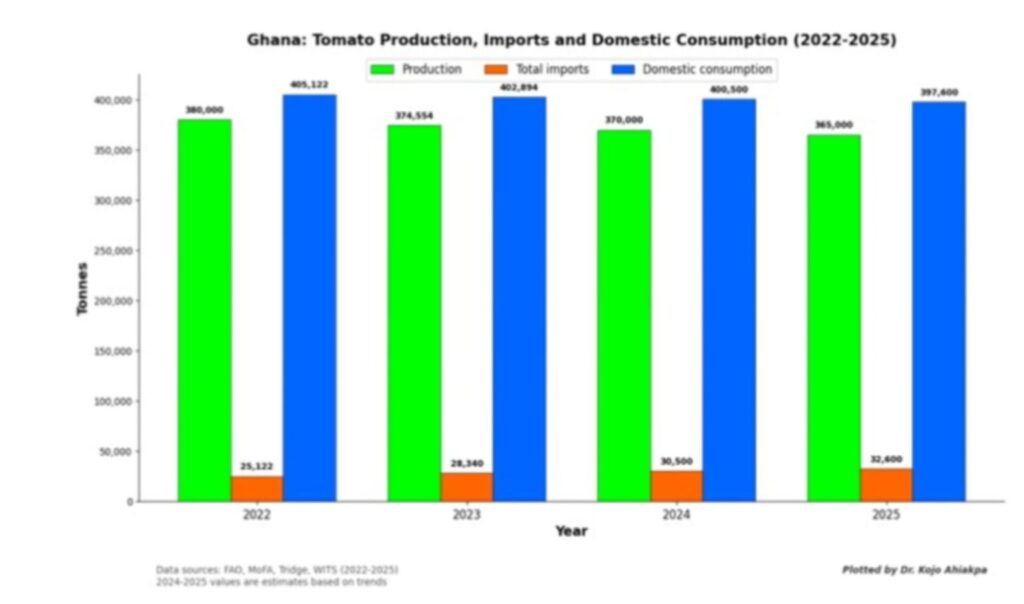
Ghana’s domestic tomato output, however, remains far below national demand. Local production hovers around 350,000 to 370,000 metric tonnes per year, while annual consumption ranges between 800,000 and 1.4 million tonnes. Only about one-third of the country’s tomato needs are met locally, forcing reliance on imports, mainly from Burkina Faso. The Chamber of Agribusiness estimates that this reliance on imported tomatoes costs Ghana roughly GH¢5.7 billion annually, about 1.2 percent of GDP.
Production in Ghana is highly seasonal. Most tomatoes ripen during the rainy season (June–July for the main crop, September–October for the minor crop), when prices are low. During the dry season (October–May), output collapses due to limited irrigation, prompting traders to import up to 100,000 tonnes annually from Burkina Faso to fill the supply gap.
Farm yields in Ghana are low by global standards, averaging 7–8 tonnes per hectare. With improved varieties, irrigation, and better farm management, yields could reach 15–20 tonnes per hectare. The current low output reflects widespread use of unimproved local varieties, scarce irrigation, limited input use, and challenges from pests, diseases, and erratic rainfall.
The government’s “seed-to-shelf” approach aims to modernise the sector, improve yields, and reduce dependence on imports, while strengthening food security and protecting the livelihoods of Ghanaian tomato traders in a volatile regional environment.