

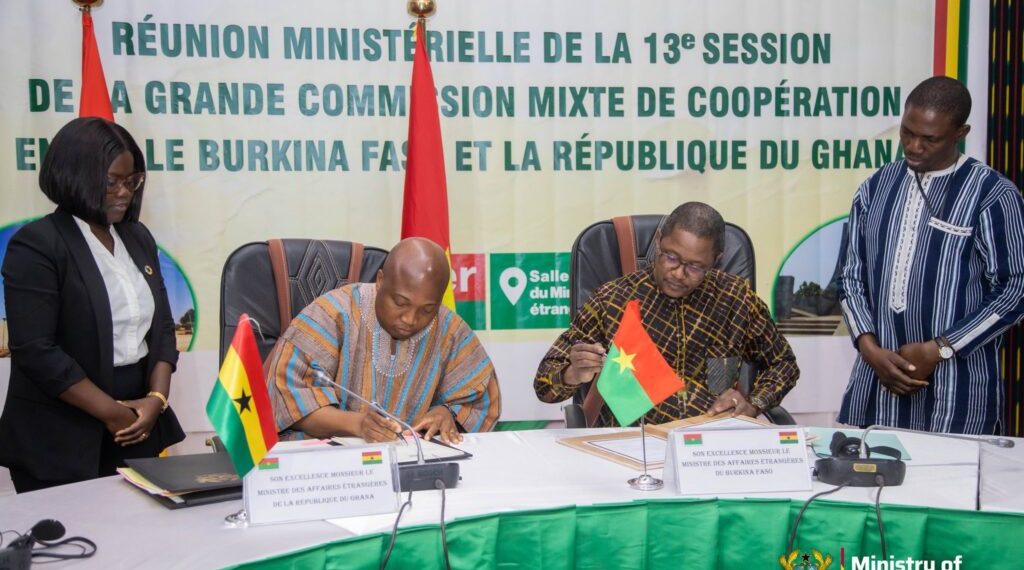
Ghana and Burkina Faso have signed seven key agreements aimed at strengthening security, improving cross-border governance, enhancing disaster management, and promoting regional integration between the two neighbouring countries.
The agreements were concluded at the end of a two-day official visit to Burkina Faso by Ghana’s Minister for Foreign Affairs, Samuel Okudzeto Ablakwa. The visit marks what officials describe as a renewed phase of engagement between Accra and Ouagadougou, focused on practical cooperation to address shared challenges.
The newly signed instruments cut across several critical areas. Among them are agreements on the mutual recognition of national driver’s licences and on transport and road transit, measures expected to ease cross-border travel and facilitate trade between the two countries.
A framework agreement on cross-border cooperation was also adopted to strengthen collaboration between border communities and administrative authorities. In addition, memoranda of understanding were signed to establish regular consultation mechanisms between border officials and to create a joint commission tasked with reaffirming and managing the Ghana–Burkina Faso boundary.
Officials say these steps are intended to reduce disputes, improve coordination, and reinforce governance structures in border areas. Further agreements focus on disaster prevention and humanitarian response, as well as joint efforts to combat the illicit cultivation, production, and trafficking of narcotic drugs and psychotropic substances.
Collectively, the agreements reflect a broad and coordinated approach to shared concerns, ranging from security and mobility to humanitarian protection and law enforcement.
Speaking after the engagements, Mr Ablakwa described his discussions with Burkina Faso’s Prime Minister, Rimtalba Jean Emmanuel Ouédraogo, as candid and forward-looking. He noted that both sides reaffirmed their commitment to mutual respect and deeper cooperation.
He also held talks with Burkina Faso’s Foreign Minister, Karamoko Jean Marie Traoré, with discussions centred on practical outcomes that would directly benefit citizens of both countries. According to Mr Ablakwa, the engagements underscored the exceptionally cordial relations between the two nations, built on shared history and common regional challenges.
Security cooperation featured prominently during the visit, particularly against the backdrop of rising terrorism and violent extremism in the sub-region. Both countries condemned recent attacks and expressed sympathy to affected families and communities. They agreed that isolated national responses are insufficient to tackle transnational threats and therefore committed to developing a joint security framework to counter terrorism and violent extremism along their shared borders.
The proposed framework is expected to enhance intelligence sharing, improve coordination among security agencies, and strengthen border surveillance. Mr Ablakwa emphasised that instability in one country poses direct risks to the other, making security collaboration essential to safeguarding development gains.
Disaster management was another major focus of the talks, especially in relation to the recurring spillage of the Bagré Dam in Burkina Faso, which has often caused flooding and displacement in downstream communities in northern Ghana. Both sides agreed to establish a partnership aimed at improving early warning systems, enhancing information sharing, and strengthening coordinated responses to humanitarian crises.
A significant outcome of the visit was the reactivation of the Permanent Joint Commission for Cooperation between Ghana and Burkina Faso, which had been inactive for six years. The move follows earlier engagements between former President John Dramani Mahama and Burkina Faso’s leader, Captain Ibrahim Traoré, aimed at revitalising bilateral ties.
The commission is expected to serve as an institutional platform for sustained dialogue, policy coordination, and monitoring of the commitments arising from the newly signed agreements.
At the close of the visit, Mr Ablakwa expressed appreciation to the government and people of Burkina Faso for their hospitality, stating that the outcomes of the meetings reflect a shared determination to translate diplomatic goodwill into tangible benefits for citizens. The agreements now move into the implementation phase, with technical committees and timelines expected to be established in the coming months.