

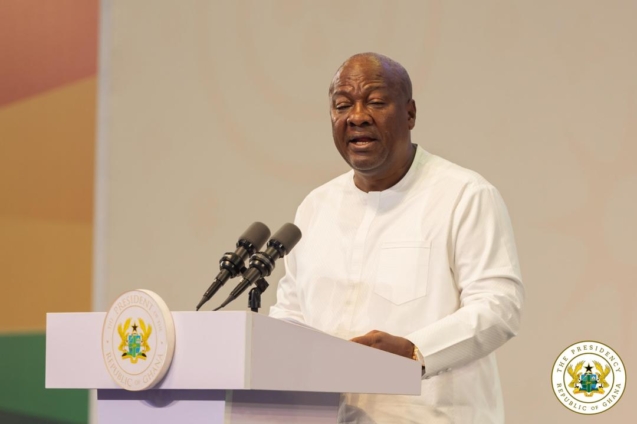
Ghana’s prolonged energy sector crisis has drained more than $8 billion from the public purse over the past nine years, severely limiting the government’s ability to fund wages, improve working conditions, and expand social protection programmes. President John Dramani Mahama issued the warning during a high-level dialogue with organised labour at Jubilee House, describing the situation as both unsustainable and damaging to the country’s already constrained finances.
According to the President, the scale of spending required to keep the power sector afloat has become a major burden on national resources. He revealed that in 2025 alone, the government paid about $1.57 billion to clear legacy debts in the sector, underscoring how past obligations continue to weigh heavily on present budgets.
For years, Ghana’s electricity system has struggled with deep structural problems across generation, transmission, and distribution. Persistent distribution losses, weak billing and metering systems, under-recovery of tariffs, unpaid debts to independent power producers, and leakages in revenue collection have created a chronic financing gap. Successive governments have stepped in with financial support to prevent severe power disruptions, but these bailouts have come at a steep cost to taxpayers.
The President stressed that the consequences extend far beyond the energy sector itself. Funds diverted to plug power-sector deficits are resources that could otherwise support pensions, healthcare, education, public sector reforms, and poverty-reduction programmes. In a period when the government is already juggling debt servicing, infrastructure demands, and compensation pressures, the recurring losses have become a major obstacle to broader development goals.
Analysts have long warned that the commercial weakness of the electricity sector poses one of the biggest threats to fiscal stability. Reliable power is essential for industrial growth, private investment, and job creation, yet the sector meant to power the economy continues to undermine the financial base needed to sustain that growth. This contradiction has created a situation where electricity remains indispensable but financially fragile.
President Mahama indicated that his administration intends to reverse the trend through a new wave of reforms aimed at restoring discipline and efficiency. Key measures include improving billing accuracy, strengthening metering systems, reducing leakages in distribution, enhancing transparency across sector agencies, and addressing inherited debts and unfavourable contracts.
Particular attention is being placed on the “last-mile” distribution stage — the point at which electricity reaches consumers. Weak metering, poor bill collection, and both technical and commercial losses at this stage have long prevented the sector from recovering the true cost of power supplied. Without fixing these issues, broader reforms may struggle to deliver meaningful results.
However, reforming the sector is politically and economically complex. Public resistance to higher utility tariffs often delays necessary price adjustments, while enforcement against non-payment has historically been inconsistent. As a result, the state frequently absorbs costs that a more efficient, commercially viable system would recover from users.
Beyond fiscal concerns, an unstable power sector also affects investor confidence. Businesses rely on predictable, affordable electricity to operate competitively, and uncertainty in energy supply or pricing can discourage industrial expansion and long-term investment.
By linking energy reform directly to wages, welfare, and national development, the President signaled that fixing the sector is no longer just a technical priority but a social and economic imperative. Still, the path to recovery will be difficult. Years of accumulated debt, institutional weaknesses, and politically sensitive pricing decisions mean that progress is likely to be gradual rather than immediate.