

Ghana’s rush to engage Burkina Faso diplomatically over its ban on fresh tomato exports is understandable. Tomatoes are not just another commodity; they are a staple in virtually every Ghanaian kitchen. But the deeper truth is uncomfortable: this disruption did not come out of nowhere. It is the predictable outcome of years of underinvestment, weak policy follow-through, and a quiet national reliance on imported produce to fill a widening domestic gap.
For several years, Ghana has produced far less tomato than it consumes. Between 2022 and 2025, annual production averaged about 450,000 metric tonnes, while consumption hovered near 589,000 metric tonnes. That left a structural deficit of more than 100,000 tonnes every year. In 2023, the shortfall ballooned to roughly 180,000 tonnes. Even in 2025, when output reached its highest level in recent memory, demand still outstripped supply by nearly 100,000 tonnes. These figures point to a country that has not built a resilient tomato industry, despite repeated promises and public spending.
Government initiatives including projects meant to boost local production and high-profile greenhouse ventures have yet to produce visible results in markets or on farms. Announcements were made, funds allocated, and facilities commissioned, but the supply gap remains stubbornly intact. A greenhouse that exists in speeches but not in supply chains does little to feed a nation.
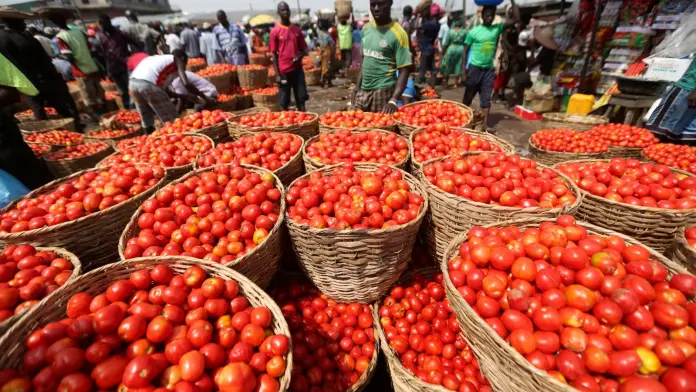
For decades, Ghana has relied heavily on tomatoes from neighboring Burkina Faso. The arrangement was convenient: imported tomatoes were abundant, affordable, and dependable. That steady flow suppressed urgency around domestic production. Now that the tap has been turned off, the vulnerability is stark.
Yet disruption can also create opportunity. The experience of Ghana’s tilapia sector offers a powerful example. About 15 years ago, the country restricted tilapia imports. Initial fears of shortages were widespread, but the policy triggered investment in hatcheries, feed mills, and aquaculture infrastructure. Today, Ghana is largely self-sufficient in tilapia production. The same transformation is possible for tomatoes if the moment is seized.
One major obstacle is cost. Farmers in Burkina Faso benefit from cheaper credit, often at single-digit interest rates, while agricultural loans in Ghana frequently carry rates approaching 30 percent or more. That difference is built into every crate of tomatoes. Ghana was not just importing produce; it was importing the advantage of a more supportive financial system.
Labour presents another challenge. Vegetable farms in Ghana often depend on workers from neighboring countries because local agricultural labour is scarce and expensive. Although tens of thousands of acres could potentially be cultivated to replace lost imports, land alone cannot solve the problem. Affordable financing, irrigation systems, mechanisation, and structured seasonal labour mobility such as frameworks envisioned under ECOWAS are all necessary.
Equally troubling is the country’s weak research foundation for tomato production. Unlike nations that have built competitive horticulture industries, Ghana lacks a sustained national breeding programme tailored to local conditions. Many tomato varieties grown in the country were developed for cooler or drier climates and struggle in Ghana’s heat and humidity. Pest pressures, particularly root-knot nematodes, further reduce yields sometimes by more than half yet farmers often lack the diagnostic support or training to address the problem effectively.
Collaboration with international research bodies such as the World Vegetable Center could accelerate the development of resilient tropical varieties, but such partnerships must be backed by consistent funding and coordinated national strategy.
Even when farmers succeed in producing tomatoes, a significant portion never reaches consumers. Post-harvest losses estimated between 25 and 50 percent occur due to poor storage, transport, and handling. Without cold storage, proper packaging, and processing facilities, expanding production alone will not guarantee food security. Investments in solar-powered cold rooms, modern crates, and processing plants could stabilize prices, reduce waste, and create new export opportunities.
The current ban may also be a warning of broader regional shifts. Ghana imports large volumes of onions and other vegetables from the Sahel. If similar restrictions extend to those crops, the resulting shortages could be even more severe. Building domestic capacity now is far less costly than scrambling during a crisis.
Ultimately, Burkina Faso’s export ban is less a diplomatic incident than a reality check. It exposes how deeply Ghana has depended on external supply for a basic food item and how little progress has been made in building a self-sustaining production system. If imports quickly resume and the country returns to business as usual, the underlying weaknesses will remain waiting for the next disruption to expose them again.
Handled wisely, however, this moment could mark the beginning of a stronger, more resilient agricultural sector one rooted in local production, scientific innovation, and farmer-friendly financing. Ghana does not lack land, expertise, or demand. What it has lacked is sustained commitment.
Source: