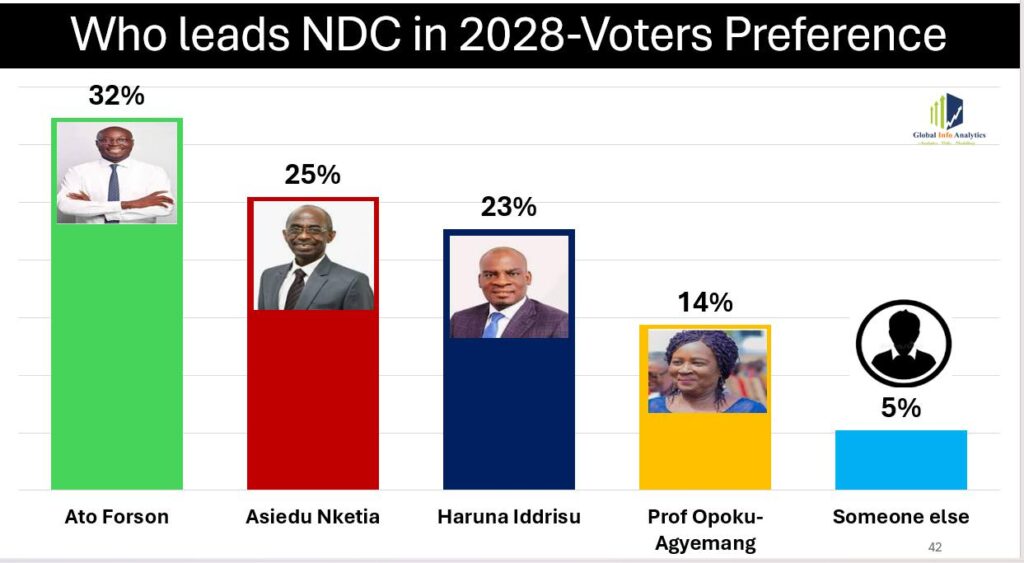
Executive Director of Global InfoAnalytics, Mussa Dankwa, has revealed that emerging polling data suggests delegates of the National Democratic Congress (NDC) are increasingly placing national interest, leadership competence, and governance performance above strict party loyalty when considering future leadership choices.
According to Mr Dankwa, the latest findings indicate that delegates are paying closer attention to qualities such as vision, effectiveness in government, and the ability to deliver results as the party gradually shifts focus toward its long-term leadership direction and the 2028 general elections.
Speaking on the findings, he noted that many delegates appear more concerned about the country’s future than internal party considerations.
“Interesting data continue to point to the fact that NDC delegates prioritise the country over their party when it comes to selecting a leader, at least for now,” he stated.
The poll showed that performance in government is becoming one of the most important factors influencing delegates’ preferences. Attention to a candidate’s performance reportedly increased from 74 percent to 78 percent, making it one of the strongest criteria among respondents.
The findings suggest delegates are likely to favour leaders with proven records in governance and administration rather than relying solely on party loyalty or long-standing internal affiliations.
Mr Dankwa also highlighted a significant rise in the importance attached to visionary leadership. According to the poll, the percentage of delegates who prioritise visionary qualities increased sharply from 53 percent to 66 percent during the period under review.
“Visionary saw astronomical rise over the period, increasing from 53 percent to 66 percent,” he explained.
Political analysts believe the shift reflects growing expectations among party delegates for leaders capable of presenting long-term solutions to Ghana’s economic and developmental challenges while inspiring broader public confidence.
The survey further showed that delegates are increasingly evaluating potential leaders based on their contributions in government. Mr Dankwa disclosed that the importance attached to being a “good servant of government” rose from 35 percent to 38 percent.
The data could favour individuals with strong records in ministerial appointments, parliamentary work, or public administration within the current government.
Although party loyalty remains a factor in the party’s internal dynamics, Mr Dankwa noted that it no longer appears to be the dominant consideration among delegates.
“The top criteria don’t suggest putting the party at the top of what they look out for,” he observed.
According to the poll, “party servant” ranked fourth among the factors delegates consider when assessing leadership contenders, recording only a marginal increase from 19 percent to 21 percent.
The findings point to an evolving political attitude within the NDC, where delegates appear more focused on competence, electability, national appeal, and governance capacity than purely partisan considerations.
Mr Dankwa believes the trend could significantly influence the party’s future leadership race and ultimately shape who leads the NDC into the 2028 elections.
“How this data unfolds going forward could determine who leads the NDC in 2028,” he stated.